
But I'm back! And I really want to write on this topic because I do care about it a lot. Also, I have this nagging feeling in the back of my mind that if I published this post, Marcus will come. So...we'll see, 'k? :)
Today, I want to continue with the pregnancy subtopic and discuss all the tests and scheduled exams that are done prior to baby being born.
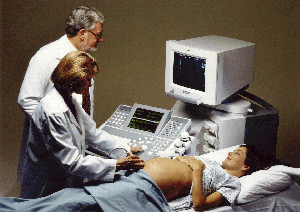 |
| "Let's all gather around this machine that goes BING!" |
- Pregnancy test - urine, blood test, beta hCG. Which to choose?
- Visits to your OB provider - when should they start? How frequently should you go?
- All the blood draws & urine tests - what are they for and why do I need so many?
- Glucose tolerance test (for gestational diabetes) - how 'bout I just skip this awful exam? Is that okay?
- Genetic screening - which ones are really necessary? How do I know I'm "at risk"? How helpful is it to pursue a conversation with a genetic counselor?
- Ultrasounds - how many should one need? Are they necessary at all?
- Group B Strep - I had strep earlier this year, does this mean I will give it to my baby?
- Fetal fibronectin test - WTH?
- Non-stress test - are they really necessary? What are they an indication of?
These OB practitioners sure do like to poke and prod pregnant women!
Yes, there are lots and lots of tests available during pregnancy. In the interest of time, I will attempt to explore the genetic testing component more in depth-ish while only briefly discussing the others. Okay, go!
Popular practice vs. evidence
There are so many of these screening and monitoring measures. Most women (well, most women who have great insurance coverage) would be overwhelmed by all these tests. However, most women will just choose to go with whatever their OB provider recommends. Besides, they know best, right? ;)
What are our options? Let's take a look at the list of tests.

- Pregnancy tests - Woohoo! You're pregnant! Or...Doh! You're pregnant! Whichever the case may be for your family, most people find out through home pregnancy tests. Nothing wrong with that. For those who want to know with more accuracy, you can get a urine hCG test in the clinic. It'll detect hCG (a pregnancy hormone produced by the placenta) at a lower threshold than many over-the-counter home pregnancy tests. But it'll only be able to tell you whether you're pregnant. If you want to know how pregnant you are (that is, exactly how much of this hCG hormone is being produced...so that you might be able to determine whether the pregnancy is viable), you'll want to do a blood draw. The blood draws are done about 48 hours apart to see whether the serum hCG is increasing at a typical rate. There's more to this, of course, and you can read all about it here.
- OB visits - Although some OB providers prefer not to see women until after 10 weeks gestation (due to the higher probability of early term miscarriages), most are happy to collect your insurance money as soon as you'd like to come in. The first visit would confirm the pregnancy with a urine test, discuss what to expect at this stage, and possibly explore your feelings about this pregnancy.
Typically, OB providers will see you every 4 weeks until 28-32 weeks, then every 2 weeks until 36 weeks, then every week. If you follow that schedule and you start seeing an OB provider when you're about 6 weeks pregnant, you'd end up with about 14 visits (not counting ultrasounds and other tests). A study on the topic of how many antenatal visits are really necessary for low-risk pregnancies in developed countries showed that pregnancy outcomes are comparable for those who do 8-12 clinic visits vs. those who do 10-14 visits. Another multi-site study in various counties found that the new model of antenatal care with a median of 5 visits for low-risk pregnancies yields similar outcomes to the older model of the more typical visit schedule as listed above. Meaning, if your pregnancy is progressing typically, save some of your co-pay money and go get a pedicure! - Routine clinical procedures - A typical OB visit includes most of these: check history, physical exam, weight, blood pressure, urine dipstick for glucosuria and proteinuria, fetal heart tones, fundal height, palpation for fetal position (Leopold maneuver). Some providers will forgo the urinalysis part, but most of these procedures are pretty routine. Other monitoring measures that are routine will test for maternal blood & Rh type, antibody screening, CBC, rubella titer (because of a high rate of birth defects associated with the disease), syphilis serology, chlamydia & gonorrhea, HIV, and pap smear...to name a few.
Now, are all of these necessary? I would say that many of them are for the general population. If you are not promiscuous and you trust your partner, you may opt to forgo some of the venereal disease testing. Some tests that may be offered to low-risk moms that I think may not be necessary include getting a urine test every time you're in the clinic and getting a thyroid function test (since your levels are likely to be off during pregnancy anyway). Even though the other tests may be necessary, it is always a good general rule to ask, "What are these tests for and what would I do with the results?" - Glucose tolerance test - For some reason, women in pregnancy experience a phenomenon where they cannot process sugar as well as during their non-pregnant state. This is partially due to decreased secretion of insulin and partially due to insulin resistance. Women who are at high risk for developing gestational diabetes mellitus (GDM) include those who are obese (BMI > 35), have past history of GDM in previous pregnancies, have close relatives with type II diabetes, and/or have a history of unexplained poor pregnancy outcomes. Maternal age (>35), ethnicity, and socio-economic status also affect your likelihood of developing GDM. GDM can result in big ol' babies, increased c-section rate, increased risk of preterm delivery, and a number of other complications for moms and babies. Furthermore, kids who are born from GDM pregnancies are at an increased risk of developing diabetes themselves. That is why testing for this condition is so routine even though the prevalence is only in about 7% of all pregnancies. So...if you are amongst those who are at risk of developing GDM, it is a good idea to follow through and get tested. But if you are not at high risk, your provider shouldn't make you endure this awful test.
Oh! And I recently discovered that instead of drinking the disgusting syrup, some providers have started to "administer" 28 jelly beans with comparable results! :D
- Genetic screening (watch out, long section!) - First, let's establish the definitions of "test" and "screening":
- Screening is a way to determine who is at risk and should consider testing. It is not diagnostic. It is not definitive. Example of a screening is the ultrasound measurement of the nuchal translucency.
- Testing is the diagnostic study performed to determine if a condition exists. Examples of tests are chorionic villus sampling (CVS) and amniocentesis.
- Common tests during pregnancy
- American Academy of Family Physician's explanations of antenatal screening & diagnosis
- Triple screen - detects 60% Down Syndrome, 5% false positive rate; detects 65% Trisomy 18; <1% false positive rate; and detects 80% neural tube defects, 5% false positive.
- Quad screen - detects 75% Down Syndrome, 5% false positive rate; detects 73% Trisomy 18; <1% false positive rate; and detects 80% neural tube defects, 5% false positive.
- Combined screen - detects 85% Down Syndrome, 5% false positive rate; detects 75% Trisomy 18; no testing for neural tube defects.
- Integrated screen - detection rate of ~92-93%, ~3% false positive rate.
- Sequential screen - similar rates as integrated

This topic can be controversial and is a touchy one for many people. There are those who oppose genetic testing and they base this judgment on the possibility that those who find out about genetic anomalies in their fetuses would choose to abort. Famous people in the news who are vocal about this topic are Rick Santorum and Sarah Palin. Santorum (whose daughter has Trisomy 18) would argue that genetic testing leads to an increased rate of abortion and if he were president *shudder* he would work toward getting genetic tests off the list of procedures to be covered by insurance. Palin, from the same side of the political fence as Santorum, however takes a different stance. During her pregnancy with her youngest child, she elected to have an amniocentesis performed on her which revealed that there was a good chance her baby had Down Syndrome. This turned out to be true. Palin later told People magazine: “I was grateful to have all those months to prepare. I can't imagine the moms that are surprised at the end. I think they have it a lot harder.”

I realize that abortion is a very sensitive subject (and one that is even more sensitive this year, being that it is an election year). This blog is not the forum where I will be discussing whether it is right or wrong to terminate a pregnancy. I will say that I know these two things for a fact: (1) abortion is legal, and (2) God doesn't hate you because of what you've done or because of whatever your view is...God loves you.
- Ultrasounds - Typically, most providers will send you for one ultrasound in the middle of your pregnancy. The purpose of this ultrasound is to monitor and compare your baby's development vs. typical development at this stage. This is also a time when you can most likely find out the sex of the baby should you choose to.
Aside from the typical mid-trimester ultrasound, here are some other times your provider might send you in for a scan: - Transvaginal ultrasound for the diagnosis of an intrauterine pregnancy - Making sure there's actually a baby in there in the wee early term. (Or, rarely, making sure that there isn't embryonic growth outside of the uterus for some reason.) I've seen this ordered far too many times for women who are just curious to know if there is a gestational sac in there and if they're really pregnant. It's nice to know, but it does not change the fact that it doesn't tell you much (and that you could still miscarry after this early scan).
- Determination of gestational age - When the provider is concerned that your belly isn't growing as it should. Or, very commonly, they just want to know what the due date should be based on measurements instead of based on your report of when your last period was. Cha ching! Lots of money for not a lot of useful information.
- Detection of multiple gestation - Think you may have twins or triplets based on your high level of hCG or just feeling lots of limbs in your belly? An ultrasound is actually a good tool in detecting that!
- Identification of congenital malformation - If there is something that's not developing in a typical fashion with your baby, a sonogram could help identify that. But evidence shows that it really depends on the technician who is doing the scan. False positives are not uncommon and, unfortunately, some fetuses are terminated based on these faulty recommendations.
- Identification & monitoring for intrauterine growth restriction (IUGR) - If the babe is for some reason not growing appropriately, a sonogram could help review the problem and monitor you throughout the pregnancy to help determine when baby needs to be delivered.
- Determination of fetal size to estimate birth weight - Okay, safe to say that this is not a routine procedure, it is not recommended as there is a margin for error, and it is really not that necessary.
- Identification of [abnormal] fetal presentation - If your OB provider cannot determine the fetal lie based on Leopold's or a cervical exam, an ultrasound would definitely be able to tell you whether baby is breeched. But oftentimes this information is interpreted to mean that the baby will definitely stay in that position until the time of birth...and that is not necessarily true. If your OB is sending you for an ultrasound to determine whether kiddo is breeched, it is so likely that s/he is (1) kind of incompetent and (2) really looking forward to collecting your c-section money.
- Part of determining the biophysical profile (BPP) of fetus - This is a package of metrics that help determine fetal well-being based on fetal heart rate, movements, tone, amniotic fluid level, etc. If you trust your OB provider, you can trust that it's necessary. I often see that OB providers will only send a woman in for a BPP if she is really nervous about baby's well-being (and her fears are not always unwarranted).
- United States Preventive Services Task Force (USPSTF): No proven perinatal benefits of sonograms at all so they are not recommending one way or another for any type of ultrasounds for low-risk pregnancies. Routine ultrasounds in the third trimester not recommended.
- National Institutes of Health (NIH): Ultrasounds should not be used for routine screening.
- American College of Obstetrics & Gynecology (ACOG): Women should be offered first-trimester screening by ultrasound (for fetal genetic anomalies) as an option, given that patients are counseled appropriately about limitations of tests.
- Additionally, Consumer Reports had an article on the top 10 procedures to reject when you're expecting and #5 was "ultrasounds after 24 weeks" as this practice is linked to a higher c-section rate.
- Group B Strep (GBS) - "I had strep earlier this year, does this mean I will give it to my baby?" No, stupid! About 10-30% of pregnant women kind of randomly (and at random times sometimes as it can be transient) carry the Group B Streptococcus bacteria. They are usually asymptomatic. However, they could pass this on to babies when they are born. So the CDC and the American Academy of Pediatrics recommend that a simple test (swab) is administered at around week 35 of pregnancy to determine if a woman is a carrier of this bacteria. If she is, perinatal prophylaxis with antibiotics will be given to mitigate transmission to babies. This test is pretty non-invasive and has legit reasoning as well as treatment plans. So, do it! :)
- Fetal fibronectin test - Fibronectin protein is something produced by the fetus. It "leaks" into the vagina if preterm labor is imminent. A fetal fibronectin (fFN) test is a simple swab that can be taken between 22 and 35 weeks gestation and the results could show whether you might deliver prematurely. If the test turns out to be negative, it is a reassuring sign that you probably won't give birth in the following 2 weeks. If the test is positive, however, it actually doesn't tell you much. Maybe you will pop within the next 2 weeks, maybe you won't. So what this means is that it's a test that could reassure you that there is high likelihood you won't deliver prematurely. Just be sure to not take the positive findings as anything conclusive.
- Non-stress test (NST) - A non-stress test is when they hook your belly up to a machine that monitors contractions and fetal heart tones so that you can determine fetal well-being. A "reactive" non-stress test is a good thing. It means baby is doing well. This test can be reassuring for moms who aren't feeling very much fetal movement or those who are overdue. This isn't a test that is recommended routinely unless there are other risks to the pregnancy...but I've seen it ordered for a fair number of unnecessary situations and moms show up to get their NST's without really being sure why they were there. *sigh*
We have opted not to do any genetic screening for all pregnancies so far. Is that the right choice? Well, I think it was the right decision for our family. Our reasoning was that our decision wouldn't make a difference whether we would keep or terminate the pregnancy (we would let God & baby decide when it was time to let go) and we didn't want the added stress of false positives. I totally see the point of view of "wanting to be prepared" and I truly respect the decision to do that.
When we had our mid-pregnancy ultrasound with our first pregnancy, we found out that our baby, Penelope Emmanuelle, had significant health problems associated with Turner Syndrome. If I had had the first trimester screening tests, it is very likely that the markers would have shown up to indicate that there were problems with the pregnancy. But we didn't have those tests. So we didn't find out about Penelope's health problems until 3 weeks before she passed away in-utero. In hind sight, I felt that this was exactly how we would have wanted it. Sure, it was a huge shock to us when we went in for that exciting "boy or girl" ultrasound and were delivered the news that "the fetus is not compatible with life." But if we'd known any earlier than at 20 weeks gestation, what would we have done? Stress out? Pray more? (Okay, that's actually a good thing.) Doubt ourselves? Throw a bigger pity party? I dunno. But we felt that the 3 weeks we had to process the news of Penelope's health problems was just about right.
For other monitoring and screening measures, we've chosen to get much more than necessary, I think, because our health insurance plan is so flippin' awesome. I received all of those tests above with the exception of genetic testing and NST (once we found out about Penelope's health issues, we did pursue testing to pinpoint the genetic problem and make sure it wasn't something that could reoccur because of our combination...and we did get to talk to a genetic counselor, which was somewhat helpful). As the insurance plan changes next year, I don't think we would agree to so many tests for the next pregnancy...if there is one.
As a general rule, please remember that you are the healthcare consumer. You have choices. You have options. Don't let OB providers (yes, midwives included!) pressure you into unnecessary procedures just because they say, "It's what's best for your baby." Discuss your options as a family unit. Trust your instincts. You can decide what's best for your family.
Acknowledgements & Resources
- This is the study comparing the number of antenatal visits for low-risk women. This is the other study that collected data from clinics in Argentina, Cuba, Saudi Arabia, and Thailand.
- A Consumer Reports article on the top overused perinatal procedures.
- The pictures are from here, here, here, and here.


No comments:
Post a Comment